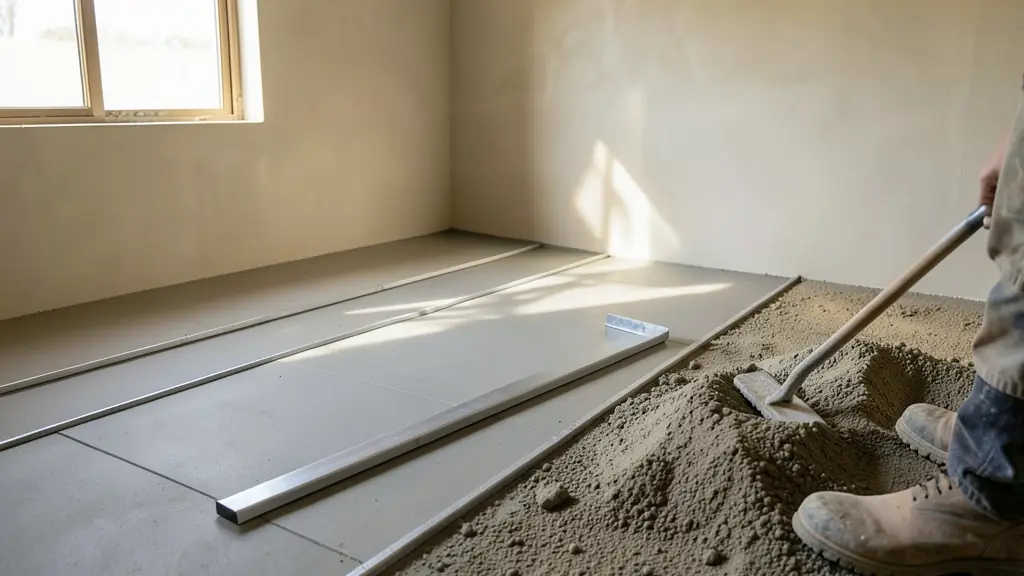
A screed is a layer of cement and sand laid over a concrete slab to give a flat, level surface for tiles, vinyl, laminate, carpet or a coating. The calculator works out the materials for a traditional sand-cement screed. Because a damp screed mix compacts down, it needs about 30% more dry material than the finished volume, which the calculator includes.
Screed thickness by type
| Screed | Thickness | Laid on |
|---|---|---|
| Bonded | 25–40 mm | A clean, rough slab with a bonding slurry or primer |
| Unbonded | 50 mm or more | A membrane or an old surface it can't bond to |
| Floating | 65–75 mm or more | Insulation boards or underfloor heating pipes |
| Self-levelling | 3–30 mm | A primed slab, for a smooth finish |
Measure the thickness at several points and use the average; floors are rarely level, and the deep spots use most of the material.
Drying time before flooring
A common rule of thumb is one day per millimetre for the first 40 mm, and about two days per millimetre after that, in a ventilated room at about 20 °C. A 50 mm screed then needs about 60 days. Cold, damp weather and closed rooms slow it down. Tiles can often go on sooner than timber, vinyl or epoxy, which need a moisture test first. Screeds also need curing: keep them covered or damp for the first few days so the surface doesn't dust or crack.
Getting a good screed
- Use clean, sharp plaster or screed sand, not building sand with clay in it.
- Mix it semi-dry: it should hold together when squeezed in your hand without water running out.
- Lay it between levelling rails and compact it well, then float it.
- Leave movement joints at doorways and in large areas, and over the slab's own joints.
Screeding a whole house or a commercial floor? Compare quotes from screeding contractors, or read about power-floated floors, which can make a separate screed unnecessary.
Frequently asked questions
How many bags of cement do I need for screeding?
What is the best mix ratio for floor screed?
How thick should a floor screed be?
How long does a screed take to dry?
More concrete calculators
- Concrete slab calculatorCubic metres and ready-mix trucks for slabs, paths and driveways, several pours on one docket.m², m³ and 6 m³ trucks
- Cement, sand and stone calculatorHow many bags of cement, and how much sand and 19 mm stone, to mix a slab by hand or in a mixer.bags, m³, tonnes and a batch
- Rib and block calculatorBeams, blocks, topping concrete, mesh and props for a rib-and-block first floor or roof slab.beams, blocks, m³, mesh and props
- Mesh and rebar calculatorSheets of reinforcing mesh with laps, or a rebar grid in metres, kilograms and 6 m lengths.sheets, kg, metres and lengths
- Foundation and footing calculatorConcrete and excavation for strip footings and column bases, with the cement bags if you mix on site.m³ concrete, trenches and spoil
- Concrete curing and strength calculatorFrom the pour date: when to walk on it, strip shutters, drive on it, remove props and lay tiles.dates and strength by day