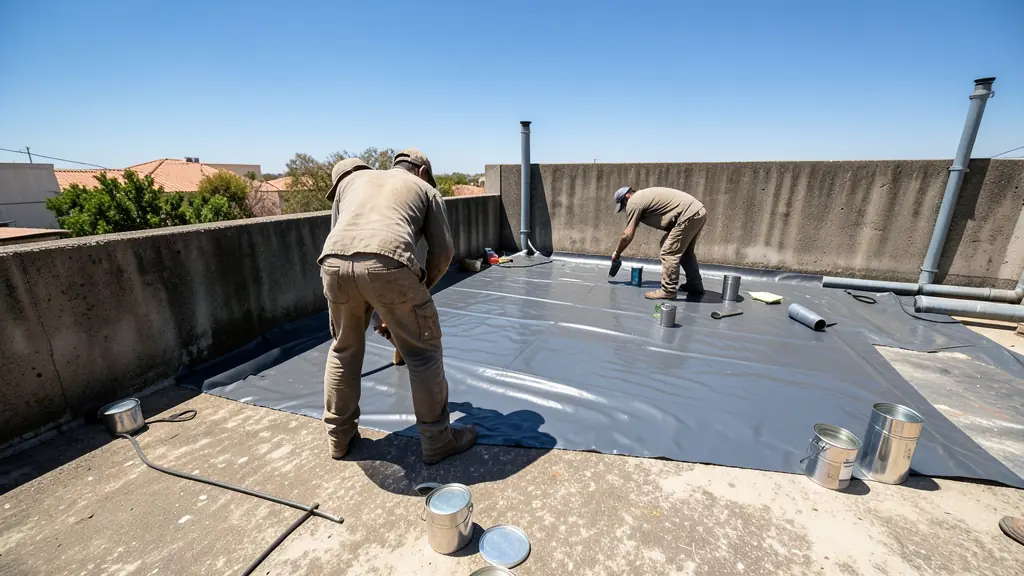
Concrete is strong but it is not waterproof. Water can pass through pores and cracks, and then rust the steel or leak into the rooms below. Concrete waterproofing protects flat roof slabs, balconies, basements, water tanks and floors that sit below ground. ConcreteSlab.co.za is a free quote service. You fill in one form and we pass your request to independent waterproofing contractors in your area, who quote you directly. We do not waterproof or sell products ourselves. There is no fee and no obligation.
Why concrete leaks
Concrete is porous. Even a well-made slab absorbs water, and shrinkage or movement opens hairline cracks. Water also finds its way through poor construction joints, around pipe penetrations and at the edges where a slab meets a wall.
The damage goes beyond a damp patch. Water carries salts and, near the coast, chloride that corrodes the reinforcing steel. The steel expands as it rusts and cracks the concrete from inside, which is called spalling. Waterproofing stops this cycle before it starts.
Types of waterproofing
The right system depends on where the water is and how the slab moves.
- Liquid membranes: bitumen-based, acrylic or polyurethane coatings, rolled or sprayed on. Common on flat roofs and balconies.
- Cementitious coatings: a cement-based slurry brushed on, often used inside tanks and basements.
- Sheet membranes: torch-on bituminous or other sheets laid in layers on roof slabs.
- Crystalline admixtures: added to the mix, or applied as a slurry, to block pores inside the concrete.
- Injection: resin or grout pumped into leaking cracks and joints.
Preparation and timing
Most waterproofing failures come from poor preparation, not poor product. The slab must be clean, sound and dry enough for the system chosen. Contractors usually grind or blast off laitance, repair cracks and cut back loose concrete first. Roof slabs also need a screed to a fall, so water runs to the outlets instead of ponding.
New concrete should cure before it is coated. Many products need about 28 days, so check the manufacturer's instructions. Rain and cold slow curing, and a coating must not be applied to a wet or very hot surface. On the Highveld, plan around afternoon storms in summer.
Under-slab protection is a different job. A damp-proof membrane (DPM) is laid under a new floor before it is poured, and is covered in its own topic.
What affects your quote
People often search for the price of waterproofing a slab per square metre. We never give prices here. Contractors will look at:
- The area and where it is: roof, balcony, basement or tank.
- The system chosen and the number of coats or layers.
- Preparation work, such as crack repair, grinding and screeding to a fall.
- Details such as upstands, drains and pipe penetrations.
- Guarantee period, access and travel distance.
Photographs of the slab and any existing leaks help contractors quote properly.
Comparing quotes for concrete waterproofing
The lowest figure is not always the best deal. When your quotes arrive, check:
- Specification: the thickness, the concrete strength in MPa, the steel and the membrane, so every quote is for the same work.
- Preparation: excavation, sub-base compaction, shuttering and who removes spoil and rubble.
- Concrete and access: ready-mix or site-mixed, whether a pump is included and any part-load or waiting charges.
- Finish, curing and guarantee: the surface finish, how long it will be cured, where joints are cut and what guarantee covers the work.
What to include in your request
- Say whether it is a roof, balcony, basement, tank or floor.
- Give the area in square metres.
- Describe where and when water gets in.
- Mention the age of the slab and any existing coating.
- Attach photographs of cracks, stains and drains.
Frequently asked questions
Does ConcreteSlab.co.za waterproof concrete?
Can I waterproof a concrete slab roof from the inside?
How long does waterproofing last?
Should new concrete be waterproofed straight away?
Concrete Waterproofing by province
- Concrete Waterproofing Gauteng
- Concrete Waterproofing Mpumalanga
- Concrete Waterproofing North West
- Concrete Waterproofing Limpopo
- Concrete Waterproofing Northern Cape
- Concrete Waterproofing Free State
- Concrete Waterproofing KwaZulu-Natal
- Concrete Waterproofing Eastern Cape
- Concrete Waterproofing Western Cape
Concrete Waterproofing by city and town
- Concrete Waterproofing in Johannesburg
- Concrete Waterproofing in Pretoria
- Concrete Waterproofing in Centurion
- Concrete Waterproofing in Midrand
- Concrete Waterproofing in Sandton
- Concrete Waterproofing in Randburg
- Concrete Waterproofing in Roodepoort
- Concrete Waterproofing in Krugersdorp
- Concrete Waterproofing in Randfontein
- Concrete Waterproofing in Germiston
- Concrete Waterproofing in Boksburg
- Concrete Waterproofing in Benoni
- Concrete Waterproofing in Kempton Park
- Concrete Waterproofing in Alberton
- Concrete Waterproofing in Vanderbijlpark
- Concrete Waterproofing in Vereeniging
- Concrete Waterproofing in eMalahleni (Witbank)
- Concrete Waterproofing in Middelburg
- Concrete Waterproofing in Secunda
- Concrete Waterproofing in Mbombela (Nelspruit)
- Concrete Waterproofing in Rustenburg
- Concrete Waterproofing in Brits
- Concrete Waterproofing in Klerksdorp
- Concrete Waterproofing in Potchefstroom
- Concrete Waterproofing in Polokwane
- Concrete Waterproofing in Tzaneen
- Concrete Waterproofing in Lephalale
- Concrete Waterproofing in Kimberley
- Concrete Waterproofing in Kathu
- Concrete Waterproofing in Upington
- Concrete Waterproofing in Bloemfontein
- Concrete Waterproofing in Welkom
- Concrete Waterproofing in Sasolburg
- Concrete Waterproofing in Durban
- Concrete Waterproofing in Pinetown
- Concrete Waterproofing in Pietermaritzburg
- Concrete Waterproofing in Richards Bay
- Concrete Waterproofing in Newcastle
- Concrete Waterproofing in Ladysmith
- Concrete Waterproofing in Gqeberha (Port Elizabeth)
- Concrete Waterproofing in East London
- Concrete Waterproofing in Kariega (Uitenhage)
- Concrete Waterproofing in Cape Town
- Concrete Waterproofing in Bellville
- Concrete Waterproofing in Paarl
- Concrete Waterproofing in Stellenbosch
- Concrete Waterproofing in George
- Concrete Waterproofing in Worcester