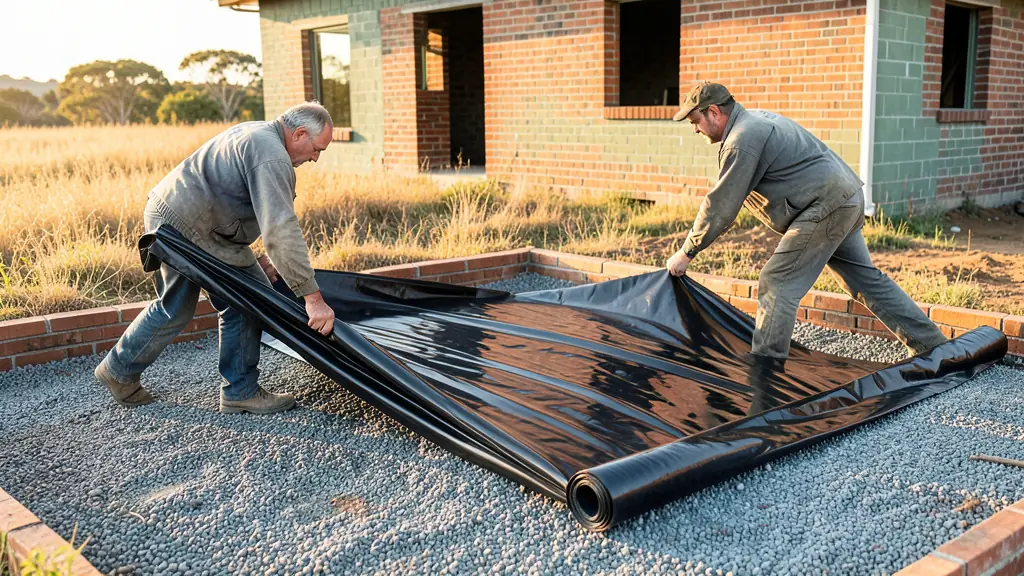
Building plastic under a concrete floor stops moisture rising from the ground into the slab and the house above. It is called a damp-proof membrane, or DPM, and it is a small cost on a floor that you cannot fix once the concrete is down. ConcreteSlab.co.za is a free quote service. You fill in one form and we pass your request to independent suppliers and merchants in your area, who quote you directly. We do not sell or lay plastic ourselves. There is no fee and no obligation.
What a damp-proof membrane does
Ground is rarely dry. Water vapour rises through a concrete slab by capillary action and can damp the floor, lift tiles, peel paint and rot timber floor coverings. A damp-proof membrane is a sheet of polyethylene laid under the slab to block that moisture.
SANS 10400-J (floors) and SANS 10400-H (foundations) set out the need for damp-proofing in houses. Under floors, the usual product is polyolefin film that complies with SANS 952, laid under the concrete.
Do not confuse the DPM with the DPC. A damp-proof course is a strip built into the walls, higher up.
Thickness: why 250 micron is common
Building plastic comes in different thicknesses, measured in microns. Thin plastic tears easily when stone is walked on or concrete is dropped onto it.
- 250 micron: the usual choice for house floors and garage slabs.
- Thinner film: often fails on rough ground and is a false saving.
- Heavier or reinforced sheets: used for industrial floors, damp sites and gas barriers.
Rolls are sold in wide widths so you can cover a house floor with few joins. Check the width and roll length with the supplier, and buy enough to allow for laps.
Laying it properly
The best membrane fails if it is torn or badly joined. Take a few minutes to get it right before the concrete arrives.
- Base: compact the ground or sand blinding and remove sharp stones.
- Laps: overlap joins by at least 150 mm and seal them with tape.
- Edges: turn the plastic up at the walls and trim it later.
- Protect it: avoid dragging mesh across it, and patch any holes.
- Termite treatment: where required, treat the soil before the plastic goes down.
On wet sites or sloping ground, ask your builder or engineer about extra drainage.
What affects your quote
People often search for the building plastic price per roll, but we never give prices here. Suppliers will look at:
- The thickness and the total area of floor to cover, with laps.
- Roll width and length.
- Jointing tape and any sand blinding.
- Delivery to site, and minimum order sizes.
- Supply only, or supply and laying with the slab.
Give the floor length and width, and suppliers can work out the number of rolls.
Comparing damp-proof membrane quotes
Concrete products are priced on the detail, so compare like with like. When quotes arrive, check:
- Exact product: the strength class, size, grade or reference number, and that it meets the relevant SANS standard.
- Quantity and minimums: the unit (m³, m², sheets, bags or panels), any minimum order and part-load charges.
- Delivery: the delivery fee, the truck size, offloading and whether the site can take the truck.
- VAT and validity: whether VAT is included, how long the price holds and the lead time.
What to include in your request
- Give the floor length and width.
- State the thickness, such as 250 micron.
- Say whether you need jointing tape.
- Mention if sand blinding is needed under the plastic.
- Give your town and whether you want it laid for you.
Frequently asked questions
Does ConcreteSlab.co.za sell building plastic?
Do I need plastic under a concrete slab?
What thickness should I use?
What is the difference between DPM and DPC?
Damp-Proof Membrane by province
- Damp-Proof Membrane Gauteng
- Damp-Proof Membrane Mpumalanga
- Damp-Proof Membrane North West
- Damp-Proof Membrane Limpopo
- Damp-Proof Membrane Northern Cape
- Damp-Proof Membrane Free State
- Damp-Proof Membrane KwaZulu-Natal
- Damp-Proof Membrane Eastern Cape
- Damp-Proof Membrane Western Cape
Damp-Proof Membrane by city and town
- Damp-Proof Membrane in Johannesburg
- Damp-Proof Membrane in Pretoria
- Damp-Proof Membrane in Centurion
- Damp-Proof Membrane in Midrand
- Damp-Proof Membrane in Sandton
- Damp-Proof Membrane in Randburg
- Damp-Proof Membrane in Roodepoort
- Damp-Proof Membrane in Krugersdorp
- Damp-Proof Membrane in Randfontein
- Damp-Proof Membrane in Germiston
- Damp-Proof Membrane in Boksburg
- Damp-Proof Membrane in Benoni
- Damp-Proof Membrane in Kempton Park
- Damp-Proof Membrane in Alberton
- Damp-Proof Membrane in Vanderbijlpark
- Damp-Proof Membrane in Vereeniging
- Damp-Proof Membrane in eMalahleni (Witbank)
- Damp-Proof Membrane in Middelburg
- Damp-Proof Membrane in Secunda
- Damp-Proof Membrane in Mbombela (Nelspruit)
- Damp-Proof Membrane in Rustenburg
- Damp-Proof Membrane in Brits
- Damp-Proof Membrane in Klerksdorp
- Damp-Proof Membrane in Potchefstroom
- Damp-Proof Membrane in Polokwane
- Damp-Proof Membrane in Tzaneen
- Damp-Proof Membrane in Lephalale
- Damp-Proof Membrane in Kimberley
- Damp-Proof Membrane in Kathu
- Damp-Proof Membrane in Upington
- Damp-Proof Membrane in Bloemfontein
- Damp-Proof Membrane in Welkom
- Damp-Proof Membrane in Sasolburg
- Damp-Proof Membrane in Durban
- Damp-Proof Membrane in Pinetown
- Damp-Proof Membrane in Pietermaritzburg
- Damp-Proof Membrane in Richards Bay
- Damp-Proof Membrane in Newcastle
- Damp-Proof Membrane in Ladysmith
- Damp-Proof Membrane in Gqeberha (Port Elizabeth)
- Damp-Proof Membrane in East London
- Damp-Proof Membrane in Kariega (Uitenhage)
- Damp-Proof Membrane in Cape Town
- Damp-Proof Membrane in Bellville
- Damp-Proof Membrane in Paarl
- Damp-Proof Membrane in Stellenbosch
- Damp-Proof Membrane in George
- Damp-Proof Membrane in Worcester