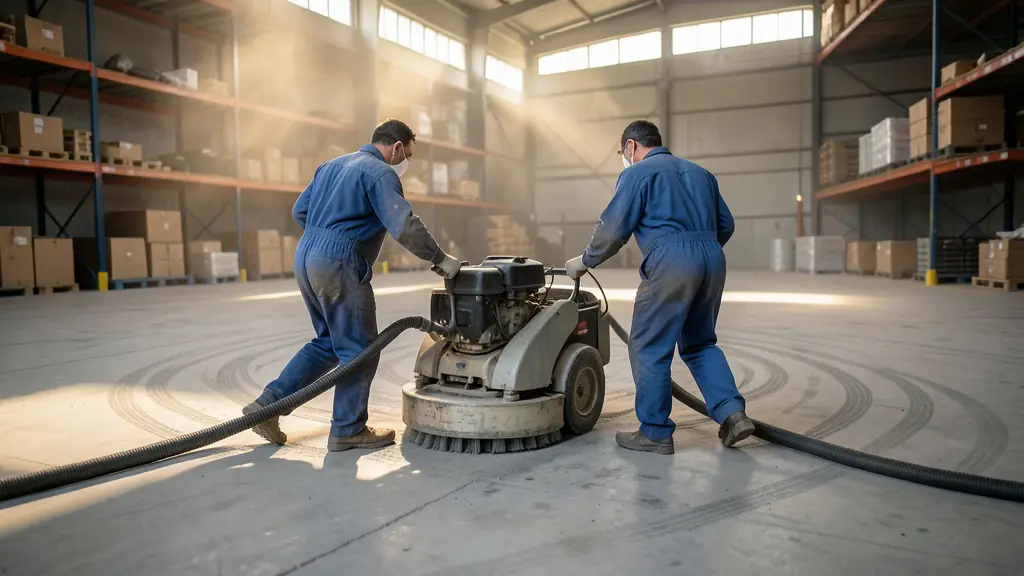
Grinding a concrete floor removes a thin layer of the surface so the slab is clean, level and ready for what comes next. It is used before epoxy, polishing, tiling and glue-down flooring, and to remove trip-hazard lips, old paint and glue. ConcreteSlab.co.za is a free quote service. You fill in one form and we pass your request to independent floor grinding contractors in your area, who quote you directly. We do not grind, coat or pour anything ourselves. There is no fee and no obligation.
What concrete grinding does
A floor grinder is a heavy machine with rotating heads fitted with diamond tooling. The heads cut away a millimetre or two of the top surface. That removes the weak, dusty cement skin (laitance), opens the pores of the concrete and leaves a clean, rough profile that coatings and adhesives can grip.
Grinding is not the same as screeding or topping. It takes concrete away and does not add any. It can flatten small high spots and remove ridges, but it cannot fix a slab that is badly out of level or cracked right through.
Common reasons to grind
Most grinding jobs fall into a few groups.
- Coating preparation: epoxy and polyurethane suppliers usually ask for a ground, dust-free surface.
- Polishing: a polished floor starts with coarse grinding and moves through finer diamond grits.
- Removing coatings: old paint, sealer, tile glue and carpet adhesive.
- Trip hazards: lips at joints and cracks in garages, walkways and warehouse aisles.
- Levelling high spots: before tiles, vinyl or a thin screed.
Dust, power and site access
Concrete dust contains fine silica, which is harmful to breathe. A good contractor grinds with a vacuum or dust extractor connected to the machine, and the operators wear respirators. Ask how dust will be controlled, especially in an occupied house, shop or factory.
Big grinders need three-phase power. If the site has none, or the supply is unreliable because of load-shedding, tell the contractors. They may bring a generator, or use a smaller single-phase machine that takes longer. Wet grinding is possible, but it leaves slurry that must be collected.
Access matters too. Machines are heavy and need a clear route in, and furniture or stock must be moved out before the work starts.
What affects your quote
People often search for the cost of grinding a concrete floor per square metre. We never give prices here, because every floor is different. Contractors will look at:
- The floor area in square metres, and how many separate rooms.
- How hard the concrete is, and its age. Power-floated slabs are harder to cut.
- What must come off: bare concrete, paint, epoxy or tile glue.
- The finish you need, such as light preparation or a deep grind.
- Dust control, power supply and travel distance to your site.
Photographs of the floor and the planned finish help contractors quote accurately.
Comparing quotes for concrete grinding
The lowest figure is not always the best deal. When your quotes arrive, check:
- Specification: the thickness, the concrete strength in MPa, the steel and the membrane, so every quote is for the same work.
- Preparation: excavation, sub-base compaction, shuttering and who removes spoil and rubble.
- Concrete and access: ready-mix or site-mixed, whether a pump is included and any part-load or waiting charges.
- Finish, curing and guarantee: the surface finish, how long it will be cured, where joints are cut and what guarantee covers the work.
What to include in your request
- Give the floor area in square metres.
- Say what is on the floor now, such as paint, glue or bare concrete.
- State what will go on afterwards: epoxy, tiles, polish or nothing.
- Mention power supply, access for machines and dust concerns.
- Attach photographs of the floor and any cracks or lips.
Frequently asked questions
Does ConcreteSlab.co.za grind concrete floors?
Do I need to grind a concrete floor before epoxy?
How much dust does floor grinding make?
Can grinding fix an uneven concrete floor?
Concrete Grinding by province
- Concrete Grinding Gauteng
- Concrete Grinding Mpumalanga
- Concrete Grinding North West
- Concrete Grinding Limpopo
- Concrete Grinding Northern Cape
- Concrete Grinding Free State
- Concrete Grinding KwaZulu-Natal
- Concrete Grinding Eastern Cape
- Concrete Grinding Western Cape
Concrete Grinding by city and town
- Concrete Grinding in Johannesburg
- Concrete Grinding in Pretoria
- Concrete Grinding in Centurion
- Concrete Grinding in Midrand
- Concrete Grinding in Sandton
- Concrete Grinding in Randburg
- Concrete Grinding in Roodepoort
- Concrete Grinding in Krugersdorp
- Concrete Grinding in Randfontein
- Concrete Grinding in Germiston
- Concrete Grinding in Boksburg
- Concrete Grinding in Benoni
- Concrete Grinding in Kempton Park
- Concrete Grinding in Alberton
- Concrete Grinding in Vanderbijlpark
- Concrete Grinding in Vereeniging
- Concrete Grinding in eMalahleni (Witbank)
- Concrete Grinding in Middelburg
- Concrete Grinding in Secunda
- Concrete Grinding in Mbombela (Nelspruit)
- Concrete Grinding in Rustenburg
- Concrete Grinding in Brits
- Concrete Grinding in Klerksdorp
- Concrete Grinding in Potchefstroom
- Concrete Grinding in Polokwane
- Concrete Grinding in Tzaneen
- Concrete Grinding in Lephalale
- Concrete Grinding in Kimberley
- Concrete Grinding in Kathu
- Concrete Grinding in Upington
- Concrete Grinding in Bloemfontein
- Concrete Grinding in Welkom
- Concrete Grinding in Sasolburg
- Concrete Grinding in Durban
- Concrete Grinding in Pinetown
- Concrete Grinding in Pietermaritzburg
- Concrete Grinding in Richards Bay
- Concrete Grinding in Newcastle
- Concrete Grinding in Ladysmith
- Concrete Grinding in Gqeberha (Port Elizabeth)
- Concrete Grinding in East London
- Concrete Grinding in Kariega (Uitenhage)
- Concrete Grinding in Cape Town
- Concrete Grinding in Bellville
- Concrete Grinding in Paarl
- Concrete Grinding in Stellenbosch
- Concrete Grinding in George
- Concrete Grinding in Worcester