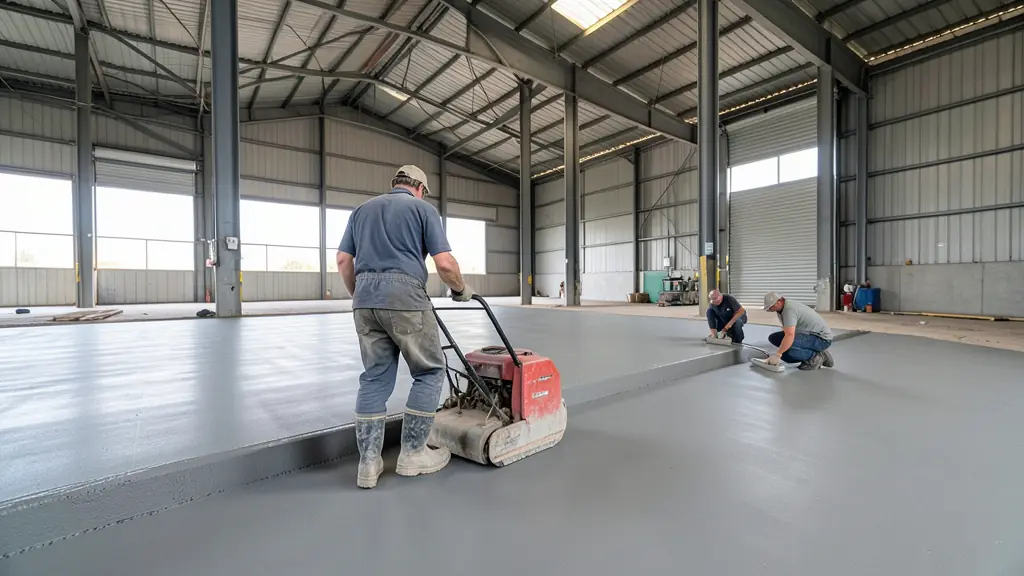
A power-floated floor is a concrete slab that is finished with a rotary machine instead of a hand trowel. The machine compacts and smooths the surface, leaving a dense, hard-wearing and flat floor. It is the standard finish for warehouses, workshops, showrooms and garages. ConcreteSlab.co.za is a free quote service. You fill in one form and we pass your request to independent concrete contractors in your area, who quote you directly. We do not pour or finish concrete ourselves. There is no fee and no obligation.
How power floating works
After the concrete is placed and levelled, it is left until the surface bleed water has gone and the slab can carry the weight of a person with only a shallow footprint. Timing is critical. Start too early and the surface is ruined. Start too late and the concrete is too hard to work.
Finishers first run a disc float over the slab to flatten it and bring up a layer of cement paste. They then switch to trowel blades, making several passes with a rising blade angle. Each pass closes the surface further and leaves it denser and harder than a hand-floated finish.
Finishes and hardeners
Not every floor needs the same finish. Common options are listed below.
- Power floated: a smooth, tight finish for most industrial and commercial floors.
- Dry-shake hardener: a powder of cement and hard aggregate broadcast on the wet slab and floated in, for heavy traffic.
- Brushed or broomed: a rougher finish for ramps and driveways where grip matters.
- Sealed floors: a curing compound or sealer applied afterwards to cut dust and stains.
A sealed concrete floor is easier to clean and resists oil and water. Ask whether the sealer suits the use of the floor, for example forklifts or food areas.
Getting a good floor
The finish is only as good as the slab beneath it. Ask for a well-compacted sub-base, a DPM of at least 250 micron under the slab to SANS 952, and reinforcement designed for the loads. Many warehouse floors use mesh or steel fibres, and an engineer should design heavy-duty floors. Ready-mixed concrete should meet SANS 878, and the usual strength is 25 to 35 MPa.
Joints matter as much as the surface. Saw-cut joints, made soon after finishing, control where shrinkage cracks form. Curing must also begin quickly, especially in hot, dry or windy weather on the Highveld. A big pour may need several finishers and a pump, and a good contractor will plan the day around delivery times.
What affects your quote
People often search for the cost of power floating per square metre. We never give prices here. Contractors will look at:
- The floor area and thickness, and the volume of concrete in cubic metres.
- The strength, reinforcement and any dry-shake hardener.
- The flatness required, particularly for racking and forklifts.
- Joint sawing, curing and sealing.
- Truck and pump access, working hours and travel distance.
A plan, the use of the floor and the loads help contractors quote accurately.
Comparing quotes for power-floated floors
The lowest figure is not always the best deal. When your quotes arrive, check:
- Specification: the thickness, the concrete strength in MPa, the steel and the membrane, so every quote is for the same work.
- Preparation: excavation, sub-base compaction, shuttering and who removes spoil and rubble.
- Concrete and access: ready-mix or site-mixed, whether a pump is included and any part-load or waiting charges.
- Finish, curing and guarantee: the surface finish, how long it will be cured, where joints are cut and what guarantee covers the work.
What to include in your request
- Give the floor area and slab thickness.
- Say what the floor will carry: cars, forklifts or racking.
- State the strength, reinforcement and finish you want.
- Mention truck and pump access to the site.
- Say whether you want joints sawn and the floor sealed.
Frequently asked questions
Does ConcreteSlab.co.za finish concrete floors?
What is a power-floated floor?
Can a power-floated floor be polished or coated later?
Why do power-floated floors crack?
Power-Floated Floors by province
- Power-Floated Floors Gauteng
- Power-Floated Floors Mpumalanga
- Power-Floated Floors North West
- Power-Floated Floors Limpopo
- Power-Floated Floors Northern Cape
- Power-Floated Floors Free State
- Power-Floated Floors KwaZulu-Natal
- Power-Floated Floors Eastern Cape
- Power-Floated Floors Western Cape
Power-Floated Floors by city and town
- Power-Floated Floors in Johannesburg
- Power-Floated Floors in Pretoria
- Power-Floated Floors in Centurion
- Power-Floated Floors in Midrand
- Power-Floated Floors in Sandton
- Power-Floated Floors in Randburg
- Power-Floated Floors in Roodepoort
- Power-Floated Floors in Krugersdorp
- Power-Floated Floors in Randfontein
- Power-Floated Floors in Germiston
- Power-Floated Floors in Boksburg
- Power-Floated Floors in Benoni
- Power-Floated Floors in Kempton Park
- Power-Floated Floors in Alberton
- Power-Floated Floors in Vanderbijlpark
- Power-Floated Floors in Vereeniging
- Power-Floated Floors in eMalahleni (Witbank)
- Power-Floated Floors in Middelburg
- Power-Floated Floors in Secunda
- Power-Floated Floors in Mbombela (Nelspruit)
- Power-Floated Floors in Rustenburg
- Power-Floated Floors in Brits
- Power-Floated Floors in Klerksdorp
- Power-Floated Floors in Potchefstroom
- Power-Floated Floors in Polokwane
- Power-Floated Floors in Tzaneen
- Power-Floated Floors in Lephalale
- Power-Floated Floors in Kimberley
- Power-Floated Floors in Kathu
- Power-Floated Floors in Upington
- Power-Floated Floors in Bloemfontein
- Power-Floated Floors in Welkom
- Power-Floated Floors in Sasolburg
- Power-Floated Floors in Durban
- Power-Floated Floors in Pinetown
- Power-Floated Floors in Pietermaritzburg
- Power-Floated Floors in Richards Bay
- Power-Floated Floors in Newcastle
- Power-Floated Floors in Ladysmith
- Power-Floated Floors in Gqeberha (Port Elizabeth)
- Power-Floated Floors in East London
- Power-Floated Floors in Kariega (Uitenhage)
- Power-Floated Floors in Cape Town
- Power-Floated Floors in Bellville
- Power-Floated Floors in Paarl
- Power-Floated Floors in Stellenbosch
- Power-Floated Floors in George
- Power-Floated Floors in Worcester