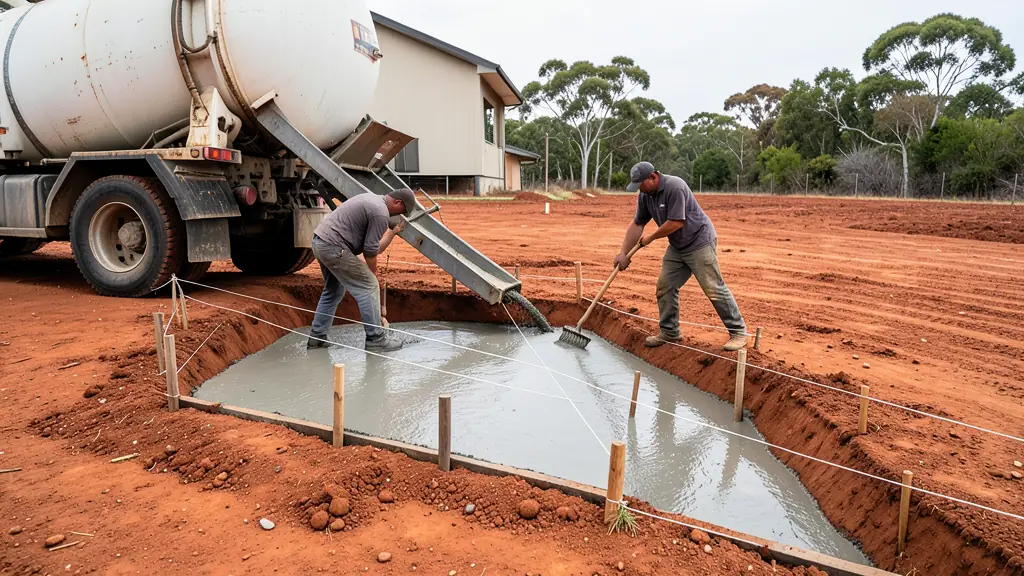
A concrete foundation spreads the weight of a building onto the ground. It might be strip footings under walls, or a raft slab under the whole house. Soil in South Africa varies a lot, so the right choice depends on the site. ConcreteSlab.co.za is a free quote service. You fill in one form and we pass your request to independent concrete contractors and ready-mix suppliers in your area, who quote you directly. We do not pour or sell concrete ourselves. There is no fee and no obligation.
Strip footings and raft foundations
Most houses sit on strip footings: a continuous band of concrete in a trench under each load-bearing wall. The wall rests on the footing, and the floor slab is cast between the walls later. People often call the combined result a concrete slab and foundation.
A raft foundation is a thick, reinforced slab under the whole building, sometimes with thickened edges. It is used where the ground is weak or moves. Both types are covered by SANS 10400-H, and on poor sites an engineer designs them.
Slab vs foundation: a foundation carries the walls into the ground, while a slab on ground is the floor. On a raft, the two are one pour. A haunch, or thickened edge, is the deeper rim of a raft slab that carries the walls. Floor thickness for a house is usually 100 mm, and thicker at the haunch.
Soil comes first
A foundation is only as good as the ground beneath it. A soil test or an engineer's site inspection tells you what you are building on.
- Expansive clay: common in parts of Gauteng and Free State. It swells when wet and shrinks when dry, and can crack walls.
- Dolomite: found around Centurion and the West Rand. It needs special precautions and engineering.
- Collapsible sands: settle when they get wet, especially along parts of the north and east.
- Coastal soils: high water tables and chlorides call for good cover to steel.
Concrete, steel and the trench
Footings are often poured in 20 to 25 MPa concrete, ready-mixed to SANS 878, with reinforcement where the design calls for it. Bars follow SANS 920, and mesh follows SANS 1024. The engineer's drawing, not habit, decides what goes in.
The trench must reach the founding depth and be clean, level and free of loose soil before the pour. Inspectors, and for new homes the NHBRC, often want to see the trench and the steel before concrete goes in. Book the truck once those checks are done. Rain in the trench is a common delay, so keep the pour date flexible.
What affects your quote
We never give prices here. Foundation work depends on the site, and quotes differ for good reasons. Contractors will look at:
- The length and size of footings, or the raft area, in m².
- The concrete volume in m³ and the strength.
- Reinforcement, and trench excavation.
- Truck access, the pour distance and whether a pump is needed.
- Part-load charges when the volume is small.
- The distance from the plant to your site.
Share your plans and any soil report with every request.
Comparing quotes for concrete foundations
The lowest figure is not always the best deal. When your quotes arrive, check:
- Specification: the thickness, the concrete strength in MPa, the steel and the membrane, so every quote is for the same work.
- Preparation: excavation, sub-base compaction, shuttering and who removes spoil and rubble.
- Concrete and access: ready-mix or site-mixed, whether a pump is included and any part-load or waiting charges.
- Finish, curing and guarantee: the surface finish, how long it will be cured, where joints are cut and what guarantee covers the work.
What to include in your request
- Attach the plans and any soil report.
- Give footing length and size, or raft area in m².
- State the concrete strength in MPa.
- Say if excavation and reinforcement are included.
- Describe truck access and the distance to the trench.
Frequently asked questions
Does ConcreteSlab.co.za build foundations?
What is the difference between a strip footing and a raft foundation?
Do I need an engineer for my foundation?
Can I mix my own concrete for footings?
Concrete Foundations by province
- Concrete Foundations Gauteng
- Concrete Foundations Mpumalanga
- Concrete Foundations North West
- Concrete Foundations Limpopo
- Concrete Foundations Northern Cape
- Concrete Foundations Free State
- Concrete Foundations KwaZulu-Natal
- Concrete Foundations Eastern Cape
- Concrete Foundations Western Cape
Concrete Foundations by city and town
- Concrete Foundations in Johannesburg
- Concrete Foundations in Pretoria
- Concrete Foundations in Centurion
- Concrete Foundations in Midrand
- Concrete Foundations in Sandton
- Concrete Foundations in Randburg
- Concrete Foundations in Roodepoort
- Concrete Foundations in Krugersdorp
- Concrete Foundations in Randfontein
- Concrete Foundations in Germiston
- Concrete Foundations in Boksburg
- Concrete Foundations in Benoni
- Concrete Foundations in Kempton Park
- Concrete Foundations in Alberton
- Concrete Foundations in Vanderbijlpark
- Concrete Foundations in Vereeniging
- Concrete Foundations in eMalahleni (Witbank)
- Concrete Foundations in Middelburg
- Concrete Foundations in Secunda
- Concrete Foundations in Mbombela (Nelspruit)
- Concrete Foundations in Rustenburg
- Concrete Foundations in Brits
- Concrete Foundations in Klerksdorp
- Concrete Foundations in Potchefstroom
- Concrete Foundations in Polokwane
- Concrete Foundations in Tzaneen
- Concrete Foundations in Lephalale
- Concrete Foundations in Kimberley
- Concrete Foundations in Kathu
- Concrete Foundations in Upington
- Concrete Foundations in Bloemfontein
- Concrete Foundations in Welkom
- Concrete Foundations in Sasolburg
- Concrete Foundations in Durban
- Concrete Foundations in Pinetown
- Concrete Foundations in Pietermaritzburg
- Concrete Foundations in Richards Bay
- Concrete Foundations in Newcastle
- Concrete Foundations in Ladysmith
- Concrete Foundations in Gqeberha (Port Elizabeth)
- Concrete Foundations in East London
- Concrete Foundations in Kariega (Uitenhage)
- Concrete Foundations in Cape Town
- Concrete Foundations in Bellville
- Concrete Foundations in Paarl
- Concrete Foundations in Stellenbosch
- Concrete Foundations in George
- Concrete Foundations in Worcester