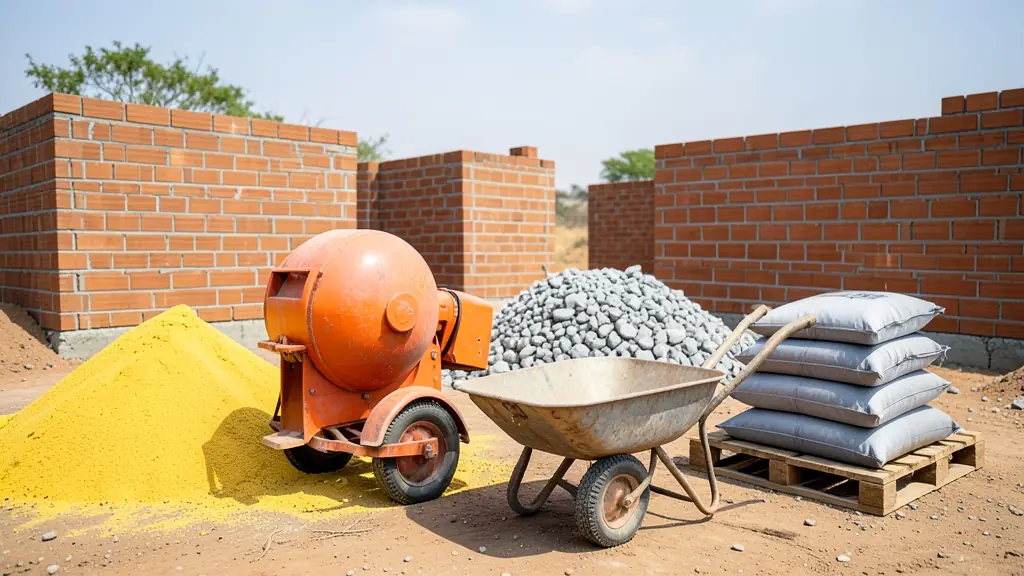
Mixing concrete yourself makes sense for small slabs, tank stands, paths and footings, or where a ready-mix truck can't reach. The calculator turns the size of the job into bags of cement, cubes of sand and stone and a recipe for each mixer batch, using typical South African mixes with 42.5 cement, clean building sand and 19 mm stone.
Typical mixes per cubic metre
These are the quantities the calculator uses for one cubic metre of concrete. They are starting points with general-purpose cement; the instructions on your cement bag or your building supplier's mix guide take priority.
| Strength | Cement (50 kg bags) | Sand | 19 mm stone | Used for |
|---|---|---|---|---|
| 15 MPa | 5½ | 0.70 m³ | 0.70 m³ | Paths, blinding, footings for garden walls |
| 20 MPa | 6½ | 0.65 m³ | 0.70 m³ | House footings, light slabs |
| 25 MPa | 7½ | 0.60 m³ | 0.70 m³ | House floors, driveways, carports |
| 30 MPa | 8½ | 0.55 m³ | 0.70 m³ | Garage floors, heavier driveways |
Sand and stone are sold by the cube (m³) or by the ton. A cube of dry building sand weighs about 1.6 tonnes and a cube of 19 mm stone about 1.45 tonnes, which is how the calculator converts. Damp sand bulks up, so a cube of wet sand holds less sand than a cube of dry sand.
Mixing it well
- Measure by the barrow, not the spade. Use the same wheelbarrow, filled level, for every batch so the mix stays the same from start to finish.
- Add water last and sparingly. Extra water makes concrete easier to place but weaker. Aim for a mix that holds its shape when you slice it with a spade.
- Mix for two to three minutes after the last ingredient goes in, and place each batch within about an hour.
- Use clean materials. Sand with clay or organic matter in it weakens concrete. Stone should be clean, crushed and graded.
- Cure it. Keep the concrete damp for at least seven days; the curing calculator gives the dates.
When ready-mix is the better buy
A 25 MPa house floor of 8 m³ needs about 60 bags of cement and roughly 5 m³ each of sand and stone, mixed in around 60 batches. A ready-mix truck delivers the same in a few minutes with a strength the plant can certify. For anything over about 3 m³, compare the price of materials and labour with a ready-mix quote. Below 1 m³, site mixing is usually the practical choice. See cement, sand and stone for bulk deliveries.
Frequently asked questions
How many bags of cement are in a cubic metre of concrete?
What is the mix ratio for a concrete slab?
How much sand and stone do I need for 1 m³ of concrete?
Is it cheaper to mix concrete myself or buy ready-mix?
More concrete calculators
- Concrete slab calculatorCubic metres and ready-mix trucks for slabs, paths and driveways, several pours on one docket.m², m³ and 6 m³ trucks
- Rib and block calculatorBeams, blocks, topping concrete, mesh and props for a rib-and-block first floor or roof slab.beams, blocks, m³, mesh and props
- Mesh and rebar calculatorSheets of reinforcing mesh with laps, or a rebar grid in metres, kilograms and 6 m lengths.sheets, kg, metres and lengths
- Foundation and footing calculatorConcrete and excavation for strip footings and column bases, with the cement bags if you mix on site.m³ concrete, trenches and spoil
- Floor screed calculatorCement and sand for a sand-cement floor screed by area, thickness and mix, and how long it takes to dry.bags, sand and drying time
- Concrete curing and strength calculatorFrom the pour date: when to walk on it, strip shutters, drive on it, remove props and lay tiles.dates and strength by day