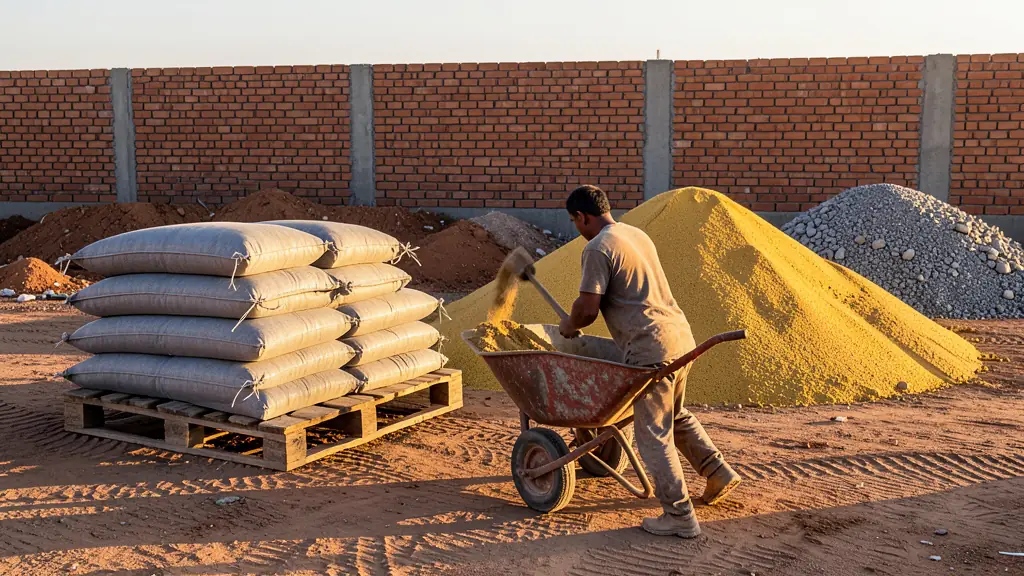
For small pours and hand-mixed concrete, you need cement, sand and stone in the right amounts. ConcreteSlab.co.za is a free quote service. You fill in one form and we pass your request to independent builders' merchants and bulk suppliers in your area, who quote you directly. We do not sell or deliver cement, sand or stone ourselves. There is no fee and no obligation, and you can compare suppliers on the materials and the delivery before you buy.
The three materials in site-mixed concrete
Concrete is cement, sand, stone and water. Each does a job.
- Cement: the binder. Common cements are made to SANS 50197-1, and general building work often uses CEM II 42.5N, sold in 50 kg bags and by the pallet.
- Sand: fills the gaps. Building sand, river sand and plaster sand differ in grading, so ask which suits concrete rather than plastering.
- Stone: the coarse aggregate. 19 mm stone is the usual size for slabs and footings, and 13 mm suits thinner work. Aggregates are covered by SANS 1083.
Clean, well-graded materials and clean water make stronger concrete.
Mixing by hand or by machine
Site-mixed concrete suits small jobs such as paths, tank stands, small pads and fence posts. A rough guide for general work is one part cement to two of sand and three of stone by volume, but recipes vary with the strength you want. Measure with the same bucket or box every time and keep the water low.
A mixer gives a more even result than a spade on a board. For anything beyond a few cubic metres, or for structural work, ready-mix concrete is usually better. It saves labour and the strength is more reliable. Your contractor or engineer can advise where the line sits.
Ordering and storing materials
Work out the concrete volume first, then ask your merchant how much of each material gives that volume. Order a little extra.
- Cement: keep bags dry, off the ground and under cover. Damp cement lumps and loses strength. Use older stock first.
- Sand and stone: bulk loads are tipped on site. Put them on plastic or a hard base so they stay clean, and out of the way of stormwater.
- Delivery: a bulk truck needs access and a tipping spot. Rural sites may pay more for distance.
What affects your quote
People search for the cement price, the cost of a bag or pallet, but it changes by region and supplier. We never give prices here. Merchants will look at:
- The brand, strength class and number of bags or pallets.
- The type and volume of sand and stone, sold by the cubic metre or load.
- Delivery distance and whether the truck can tip on site.
- Offloading, minimum order size and any pallet deposit.
Give clear quantities and your quotes will be easy to compare.
Comparing cement, sand and stone quotes
Concrete products are priced on the detail, so compare like with like. When quotes arrive, check:
- Exact product: the strength class, size, grade or reference number, and that it meets the relevant SANS standard.
- Quantity and minimums: the unit (m³, m², sheets, bags or panels), any minimum order and part-load charges.
- Delivery: the delivery fee, the truck size, offloading and whether the site can take the truck.
- VAT and validity: whether VAT is included, how long the price holds and the lead time.
What to include in your request
- Number of bags or pallets of cement
- Type and volume of sand and stone in m³
- Delivery address and tipping spot
- What you are casting, and the strength
- Date you need the materials
Frequently asked questions
Does ConcreteSlab.co.za sell cement, sand or stone?
How much cement do I need for a slab?
What stone size should I use?
Can sand and stone be delivered in bulk?
Cement, Sand and Stone by province
- Cement, Sand and Stone Gauteng
- Cement, Sand and Stone Mpumalanga
- Cement, Sand and Stone North West
- Cement, Sand and Stone Limpopo
- Cement, Sand and Stone Northern Cape
- Cement, Sand and Stone Free State
- Cement, Sand and Stone KwaZulu-Natal
- Cement, Sand and Stone Eastern Cape
- Cement, Sand and Stone Western Cape
Cement, Sand and Stone by city and town
- Cement, Sand and Stone in Johannesburg
- Cement, Sand and Stone in Pretoria
- Cement, Sand and Stone in Centurion
- Cement, Sand and Stone in Midrand
- Cement, Sand and Stone in Sandton
- Cement, Sand and Stone in Randburg
- Cement, Sand and Stone in Roodepoort
- Cement, Sand and Stone in Krugersdorp
- Cement, Sand and Stone in Randfontein
- Cement, Sand and Stone in Germiston
- Cement, Sand and Stone in Boksburg
- Cement, Sand and Stone in Benoni
- Cement, Sand and Stone in Kempton Park
- Cement, Sand and Stone in Alberton
- Cement, Sand and Stone in Vanderbijlpark
- Cement, Sand and Stone in Vereeniging
- Cement, Sand and Stone in eMalahleni (Witbank)
- Cement, Sand and Stone in Middelburg
- Cement, Sand and Stone in Secunda
- Cement, Sand and Stone in Mbombela (Nelspruit)
- Cement, Sand and Stone in Rustenburg
- Cement, Sand and Stone in Brits
- Cement, Sand and Stone in Klerksdorp
- Cement, Sand and Stone in Potchefstroom
- Cement, Sand and Stone in Polokwane
- Cement, Sand and Stone in Tzaneen
- Cement, Sand and Stone in Lephalale
- Cement, Sand and Stone in Kimberley
- Cement, Sand and Stone in Kathu
- Cement, Sand and Stone in Upington
- Cement, Sand and Stone in Bloemfontein
- Cement, Sand and Stone in Welkom
- Cement, Sand and Stone in Sasolburg
- Cement, Sand and Stone in Durban
- Cement, Sand and Stone in Pinetown
- Cement, Sand and Stone in Pietermaritzburg
- Cement, Sand and Stone in Richards Bay
- Cement, Sand and Stone in Newcastle
- Cement, Sand and Stone in Ladysmith
- Cement, Sand and Stone in Gqeberha (Port Elizabeth)
- Cement, Sand and Stone in East London
- Cement, Sand and Stone in Kariega (Uitenhage)
- Cement, Sand and Stone in Cape Town
- Cement, Sand and Stone in Bellville
- Cement, Sand and Stone in Paarl
- Cement, Sand and Stone in Stellenbosch
- Cement, Sand and Stone in George
- Cement, Sand and Stone in Worcester