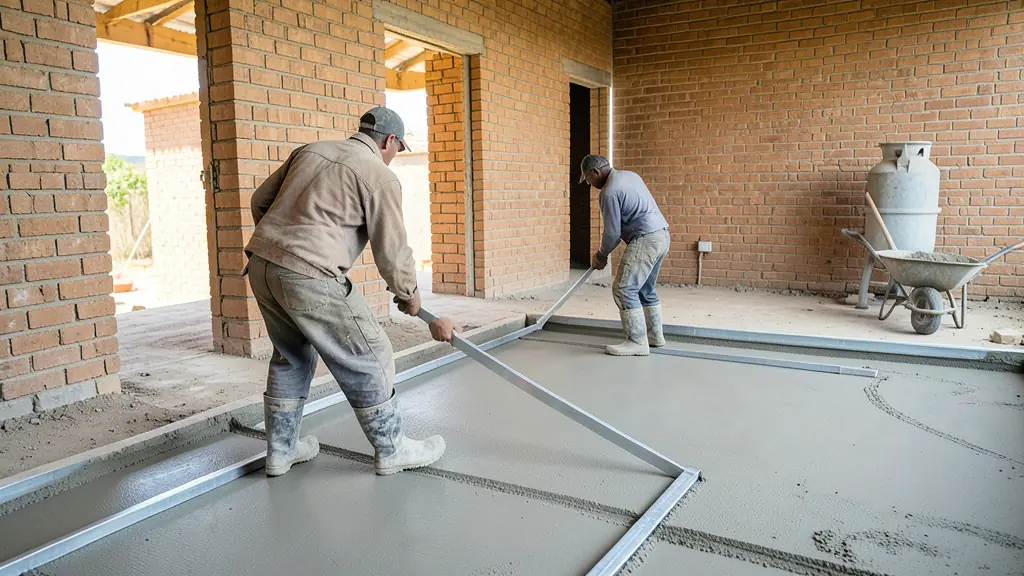
A floor screed is a thin layer of sand and cement, or a pourable levelling compound, laid over a slab to give a flat, smooth surface for tiles, vinyl, timber or carpet. ConcreteSlab.co.za is a free quote service. You fill in one form and we pass your request to independent screeding contractors and builders in your area, who quote you directly. We do not mix or lay screed ourselves. There is no fee and no obligation.
What a floor screed does
A concrete slab is rarely flat enough for a finished floor. Screeding fixes this. It evens out high and low spots, gives a smooth, hard surface, and sets the final floor level so that doors and thresholds line up.
Screed is also used to lay a fall toward a drain in a bathroom, balcony or garage, and to cover pipes or underfloor heating. It is usually a mix of building sand and cement, such as CEM II 42.5N to SANS 50197-1, mixed on site or delivered as a ready-mixed product.
Types of screed
The right type depends on the floor covering and the thickness you need.
- Bonded screed: laid on a prepared, clean slab so it grips. Usually 25 to 40 mm.
- Unbonded or floating screed: laid over a membrane or insulation. Usually 50 mm or more.
- Self-levelling screed: a pourable compound that finds its own level. It suits thin layers over a sound base before vinyl or timber.
- Fibre-reinforced screed: fibres help control shrinkage cracks.
Thin sand and cement screeds need good mixing, compaction and curing. A weak or dry mix will dust and crumble.
Preparation, drying and common problems
Most screed failures come from poor preparation. The slab must be clean, free of oil and laitance, and sound. For a bonded screed, a bonding agent or slurry coat is normally applied first.
- Curing: keep the screed damp and covered for the first days. Fast drying in hot, dry weather causes cracks and curling.
- Drying time: allow it to dry before laying vinyl, timber or glue-down finishes. Ask your contractor for a moisture check.
- Hollow spots: tap the surface. A hollow sound means poor bond.
- Cold mornings: on the Highveld, frost can damage a fresh screed.
What affects your quote
People often search for the screeding price per square metre, but we never give prices here. Contractors will look at:
- The floor area and the thickness needed.
- The type: sand and cement, fibre-reinforced or self-levelling.
- The state of the slab and how much preparation it needs.
- Falls, steps or levels that must be set out.
- Access for materials, upstairs work, and travel distance.
Say what floor covering will go on top, because that decides how flat and how dry the screed must be.
Comparing quotes for floor screeding
The lowest figure is not always the best deal. When your quotes arrive, check:
- Specification: the thickness, the concrete strength in MPa, the steel and the membrane, so every quote is for the same work.
- Preparation: excavation, sub-base compaction, shuttering and who removes spoil and rubble.
- Concrete and access: ready-mix or site-mixed, whether a pump is included and any part-load or waiting charges.
- Finish, curing and guarantee: the surface finish, how long it will be cured, where joints are cut and what guarantee covers the work.
What to include in your request
- Give the floor area in square metres and the rooms involved.
- State the thickness needed, or the high and low spots.
- Say what floor covering will go on top.
- Mention falls, drains, underfloor heating or steps.
- Add your town, floor level and access for materials.
Frequently asked questions
Does ConcreteSlab.co.za lay floor screed?
What is the difference between screed and concrete?
How long must a screed dry before tiling?
How do I find floor screeding near me?
Floor Screeding by province
- Floor Screeding Gauteng
- Floor Screeding Mpumalanga
- Floor Screeding North West
- Floor Screeding Limpopo
- Floor Screeding Northern Cape
- Floor Screeding Free State
- Floor Screeding KwaZulu-Natal
- Floor Screeding Eastern Cape
- Floor Screeding Western Cape
Floor Screeding by city and town
- Floor Screeding in Johannesburg
- Floor Screeding in Pretoria
- Floor Screeding in Centurion
- Floor Screeding in Midrand
- Floor Screeding in Sandton
- Floor Screeding in Randburg
- Floor Screeding in Roodepoort
- Floor Screeding in Krugersdorp
- Floor Screeding in Randfontein
- Floor Screeding in Germiston
- Floor Screeding in Boksburg
- Floor Screeding in Benoni
- Floor Screeding in Kempton Park
- Floor Screeding in Alberton
- Floor Screeding in Vanderbijlpark
- Floor Screeding in Vereeniging
- Floor Screeding in eMalahleni (Witbank)
- Floor Screeding in Middelburg
- Floor Screeding in Secunda
- Floor Screeding in Mbombela (Nelspruit)
- Floor Screeding in Rustenburg
- Floor Screeding in Brits
- Floor Screeding in Klerksdorp
- Floor Screeding in Potchefstroom
- Floor Screeding in Polokwane
- Floor Screeding in Tzaneen
- Floor Screeding in Lephalale
- Floor Screeding in Kimberley
- Floor Screeding in Kathu
- Floor Screeding in Upington
- Floor Screeding in Bloemfontein
- Floor Screeding in Welkom
- Floor Screeding in Sasolburg
- Floor Screeding in Durban
- Floor Screeding in Pinetown
- Floor Screeding in Pietermaritzburg
- Floor Screeding in Richards Bay
- Floor Screeding in Newcastle
- Floor Screeding in Ladysmith
- Floor Screeding in Gqeberha (Port Elizabeth)
- Floor Screeding in East London
- Floor Screeding in Kariega (Uitenhage)
- Floor Screeding in Cape Town
- Floor Screeding in Bellville
- Floor Screeding in Paarl
- Floor Screeding in Stellenbosch
- Floor Screeding in George
- Floor Screeding in Worcester