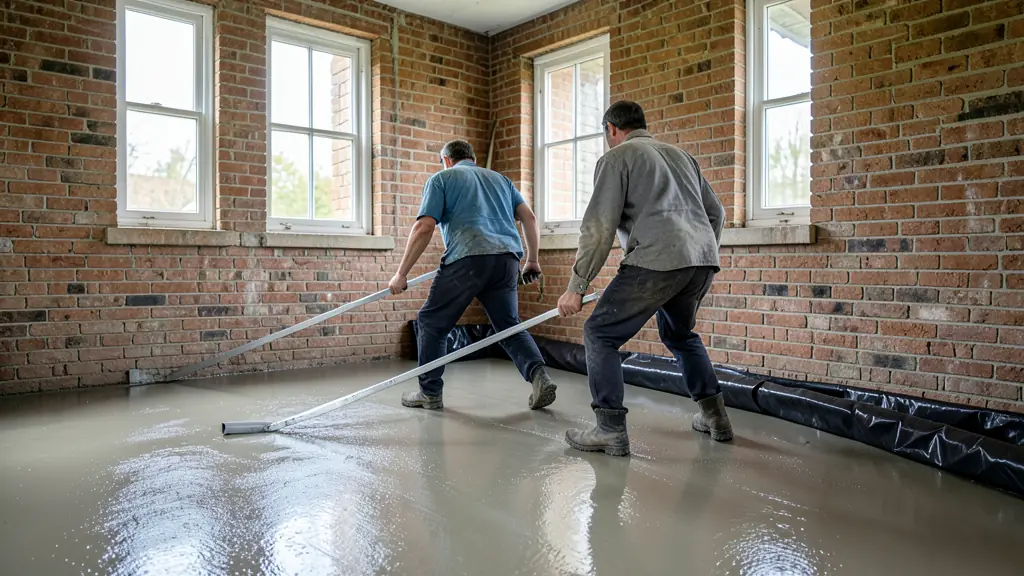
A concrete floor is the base of most South African homes, garages and workshops. A ground-bearing floor, often called a surface bed, sits on compacted fill and a damp-proof membrane. ConcreteSlab.co.za is a free quote service. You fill in one form and we pass your request to independent concrete contractors and ready-mix suppliers in your area, who quote you directly. We do not pour, sell or deliver concrete ourselves. There is no fee and no obligation, and you can compare more than one quote.
How a ground floor slab is built
A concrete slab on ground is built in layers. Under it lies compacted fill, then a damp-proof membrane, then mesh, then the concrete. Each layer has a job, and skipping one is how floors fail.
- Fill: clean, well-compacted material, placed in layers.
- Membrane: 250 micron polyethylene to SANS 952, with taped or lapped joints, keeps rising damp out.
- Reinforcement: light mesh such as Ref 193 to SANS 1024 helps control cracking.
- Concrete: usually 25 MPa, ready-mixed to SANS 878.
- Insulation: boards under or on the slab can cut heat loss, and suit cold Highveld homes with underfloor heating.
Curing time matters. Keep the slab damp for about seven days. It reaches design strength at 28 days, and light foot traffic is possible after a day or two.
Thickness, joints and floor types
Concrete floor thickness is usually 100 mm for a house floor and 125 to 150 mm for a garage or a floor that takes vehicles. SANS 10400-J sets the rules for floors in buildings. Heavier loads need an engineer.
All slabs crack at some point. Saw-cut or formed joints decide where. Joints are normally placed every few metres, or so that panels stay roughly square.
Floor finishes vary. A steel-floated or power-floated surface suits garages and workshops. Smooth floors can be polished, ground or coated later. A sand-cement screed on top is common where tiles go down.
Local conditions
Expansive clay under a house floor can heave and crack the slab. An engineer may call for a deeper fill layer or a stiffer slab. On dolomite and collapsible sands, ground preparation matters even more.
Pour on a cool day if you can. In hot, windy weather, fresh concrete dries too fast and cracks, so cover and cure it. On the Highveld, frost can damage a young slab left exposed overnight. Trucks need to reach the site, and a long wheelbarrow run adds labour. If a pump is needed, say so when you ask for quotes.
What affects your quote
We never give prices here. The cost of a concrete floor comes down to size and site. Contractors and suppliers will look at:
- The floor area in m² and the thickness in mm.
- The concrete volume in m³ and the strength class.
- Fill, compaction, membrane and mesh.
- The finish: float, steel trowel, power float or screed.
- Joint cutting.
- Part-load charges for small pours, and the delivery distance.
A short sketch with dimensions gives contractors what they need.
Comparing quotes for concrete floors
The lowest figure is not always the best deal. When your quotes arrive, check:
- Specification: the thickness, the concrete strength in MPa, the steel and the membrane, so every quote is for the same work.
- Preparation: excavation, sub-base compaction, shuttering and who removes spoil and rubble.
- Concrete and access: ready-mix or site-mixed, whether a pump is included and any part-load or waiting charges.
- Finish, curing and guarantee: the surface finish, how long it will be cured, where joints are cut and what guarantee covers the work.
What to include in your request
- Give the floor area in m² and thickness in mm.
- Say what the floor is for: house, garage or workshop.
- State the finish you want.
- Note whether fill, membrane and mesh are included.
- Describe truck access and any steps or levels.
Frequently asked questions
Does ConcreteSlab.co.za pour concrete floors?
How thick should a concrete floor be?
Do I need a membrane under a concrete floor?
Why does my concrete floor crack?
Concrete Floors by province
- Concrete Floors Gauteng
- Concrete Floors Mpumalanga
- Concrete Floors North West
- Concrete Floors Limpopo
- Concrete Floors Northern Cape
- Concrete Floors Free State
- Concrete Floors KwaZulu-Natal
- Concrete Floors Eastern Cape
- Concrete Floors Western Cape
Concrete Floors by city and town
- Concrete Floors in Johannesburg
- Concrete Floors in Pretoria
- Concrete Floors in Centurion
- Concrete Floors in Midrand
- Concrete Floors in Sandton
- Concrete Floors in Randburg
- Concrete Floors in Roodepoort
- Concrete Floors in Krugersdorp
- Concrete Floors in Randfontein
- Concrete Floors in Germiston
- Concrete Floors in Boksburg
- Concrete Floors in Benoni
- Concrete Floors in Kempton Park
- Concrete Floors in Alberton
- Concrete Floors in Vanderbijlpark
- Concrete Floors in Vereeniging
- Concrete Floors in eMalahleni (Witbank)
- Concrete Floors in Middelburg
- Concrete Floors in Secunda
- Concrete Floors in Mbombela (Nelspruit)
- Concrete Floors in Rustenburg
- Concrete Floors in Brits
- Concrete Floors in Klerksdorp
- Concrete Floors in Potchefstroom
- Concrete Floors in Polokwane
- Concrete Floors in Tzaneen
- Concrete Floors in Lephalale
- Concrete Floors in Kimberley
- Concrete Floors in Kathu
- Concrete Floors in Upington
- Concrete Floors in Bloemfontein
- Concrete Floors in Welkom
- Concrete Floors in Sasolburg
- Concrete Floors in Durban
- Concrete Floors in Pinetown
- Concrete Floors in Pietermaritzburg
- Concrete Floors in Richards Bay
- Concrete Floors in Newcastle
- Concrete Floors in Ladysmith
- Concrete Floors in Gqeberha (Port Elizabeth)
- Concrete Floors in East London
- Concrete Floors in Kariega (Uitenhage)
- Concrete Floors in Cape Town
- Concrete Floors in Bellville
- Concrete Floors in Paarl
- Concrete Floors in Stellenbosch
- Concrete Floors in George
- Concrete Floors in Worcester